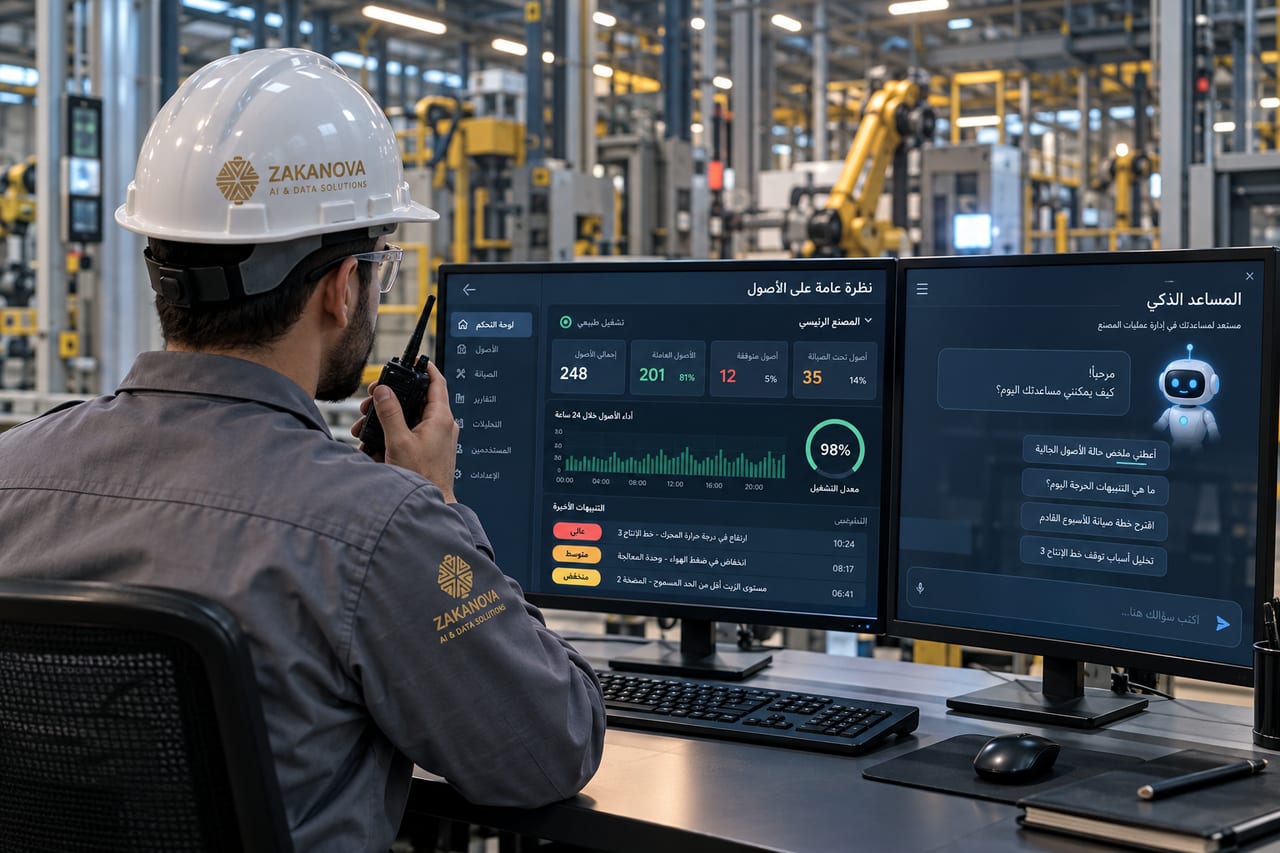
Bolting a translation layer onto an English model does not give you Arabic. On a plant floor, that gap is measured in downtime — and sometimes in safety.
Almost every industrial AI platform sold into the Gulf handles Arabic the same way: an English-first model with a translation layer at each end. The technician types Arabic, it becomes English, the model reasons in English, the answer comes back translated. It demos beautifully — until it meets a night-shift work order written in Gulf dialect, with an English equipment term and a tag number embedded mid-sentence. Arabic is not a display setting you switch on at the end. It is an architecture decision you make at the start.
So is the fix simply to buy an Arabic model?
Not quite — retrieval is where Arabic deployments actually break
The knowledge in a Saudi plant is inherently bilingual. OEM manuals and equipment documentation are overwhelmingly English. But work orders, shift handovers, and the informal notes carrying the real diagnostic history are Arabic — often dialectal, often mixed.
Most systems answer questions by first searching your documents and then writing from what they find — an approach known as retrieval-augmented generation. Recent research on the cross-lingual version finds that the search step, not the writing step, is the critical bottleneck: performance drops sharply when the query language differs from the document language, and the failure traces to the retriever’s difficulty ranking documents across languages at all. What recovers the loss is handling language during the search itself, either by searching both language pools or by translating the query before retrieval rather than translating the answer after it.
So the layer at which you handle language decides whether the system works. An Arabic-first design searches across both corpora, then answers in Arabic grounded on whatever it found, in whichever language it found it. Translate at the wrong layer and you get a fluent Arabic answer built on documents the retriever never surfaced.
The plant floor does not speak Modern Standard Arabic
Nearly all Arabic training data is Modern Standard Arabic, the formal register of newspapers and official documents. Nobody writes a 3 a.m. shift note in it. Dialectal benchmarks consistently show that strong MSA performance does not transfer cleanly to regional varieties. Gulf Arabic fares better than most because it sits closer to MSA, and independent evaluation of ALLaM 34B found Najdi and Hijazi among its stronger dialects — but “better than most” is not a specification for a safety-critical system.
Terminology is the subtler trap. Technicians code-switch constantly, using Arabised English for equipment — بيرنق for bearing, فالف for valve — alongside formal Arabic terms. A translation layer that “corrects” the technician’s word to the dictionary word silently breaks the match against years of work-order history. Analyses of multilingual pipelines call this domain misalignment: inexpert translation either transliterates terms that already have native equivalents, or translates industry-standard English terms that professionals deliberately keep in English. Both directions break your search.
Fluent, confident, and wrong
Translation pipelines are very good at producing output that is grammatically immaculate and functionally broken — what auditors of multilingual systems now call fluent hallucinations. Reviewers, including native speakers, tend to read polish as correctness.
In a chatbot that is embarrassing. In a plant, a confidently phrased Arabic instruction that has inverted an isolation step or dropped a negation is a safety event waiting for a night shift. Fluency and accuracy are different properties, and in Arabic the distance between them is wider than most buyers assume.
Why this matters more in the Kingdom
Arabic-first AI has stopped being aspirational here. ALLaM was built by SDAIA’s National Center for AI on a purpose-built Arabic corpus, its commercial deployment now sits with HUMAIN, and it is distributed through major cloud and enterprise catalogues. The sovereign Arabic model layer is real infrastructure, not a roadmap slide.
That converges with two forces every plant leader already feels. Data sovereignty, because for sensitive operational data, language capability and deployment location are the same conversation. And Saudization — capturing senior-engineer judgement in software only scales if the newest Saudi technician can interrogate it in the register they actually speak. An English-first system with a translation veneer quietly reintroduces the exact barrier localisation is meant to remove.
How Zakanova puts it together
We treat Arabic as an architectural requirement, not a localisation task. Deep-learning models handle anomaly detection, fault classification, and remaining-useful-life prognostics on sensor data — that layer is language-neutral. Above it sits Arabic-aware tokenisation and embeddings chosen against real plant text, retrieval that searches your English manuals and Arabic work orders together, a bilingual equipment vocabulary tied to your asset register, and generation grounded strictly in retrieved documents with the source shown.
Technicians ask in the language and register they actually use. Answers come back traceable to the manual page or work order behind them, with a human approving anything that touches live equipment. Outcomes depend on your assets and documentation — but Arabic is engineered into the system rather than wrapped around it.
Key takeaways
- A translation layer around an English-first model is not Arabic support; morphology, terminology, and register are lost in the round-trip.
- Tokenisation is a hidden tax: Arabic can consume two to four times as many tokens, shrinking the context window and raising cost, latency, and error rates.
- Retrieval, not generation, is where bilingual plant deployments break; language must be handled at the search layer itself.
- Plant-floor Arabic is dialectal and mixed; over-translating equipment terms breaks the match against work-order history.
- Fluent output is not necessarily correct; grounding in documents, traceability, and native Arabic evaluation are non-negotiable.
Test it in your own language
The fastest way to tell an Arabic-first system from an Arabic-enabled one is to point it at your own documents and let your own technicians question it. Zakanova can run that test on a sample of your manuals and work orders — in Arabic, in dialect, on your equipment.
Book a demo or talk to our reliability experts to see it working on your assets.