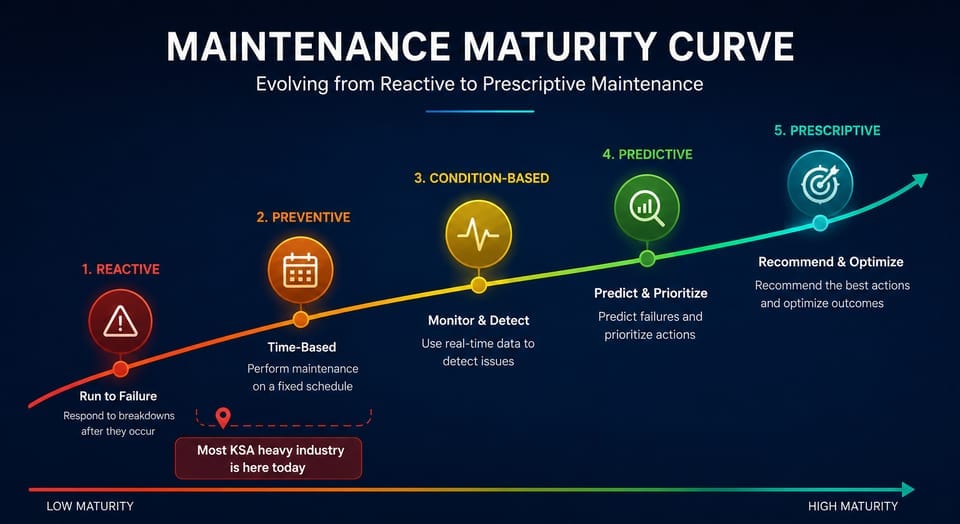
The status quo looks affordable. The numbers tell a different story.
Walk most plant floors in the Kingdom and maintenance looks like it’s working. Production runs, the big assets turn, and the monthly maintenance budget lands roughly where it always does. But “running” and “running well” are not the same thing — and the gap between them is where a surprising amount of money, uptime, and safety quietly leaks away.
The maintenance your plant actually does today
Most operations run a blend of three maintenance styles, often without naming them. The first is reactive — run an asset until it breaks, then fix it. It feels cheap because nothing is spent until something fails. The second is preventive — service equipment on a fixed calendar or running-hours schedule, whether or not it needs it. The third, more advanced, is condition-based — watch a handful of sensor readings and act when one crosses a threshold.
Each has its place. Reactive is fine for a light fitting in a warehouse. Preventive brought real discipline when it replaced pure firefighting. But here is the uncomfortable truth most reliability leaders already feel: a large share of heavy industry still sits closer to the reactive-and-calendar end of that spectrum than to genuine prediction. And that position carries a cost that rarely appears as a single line on any report.
The cost that never shows up on the P&L
When a critical compressor or pump fails without warning, the repair bill is the smallest part of the damage. The real losses hide elsewhere: the production that never got made while the line was down, the knock-on delays to everything downstream, the overtime and expedited spares, and the quiet erosion of overall equipment effectiveness. In a capital-intensive, 24/7 operation, an hour of unplanned downtime on the wrong asset can dwarf a month of maintenance labour.
Calendar-based maintenance carries its own hidden bill, pointing the opposite way. Replacing parts that still had useful life left, opening up healthy machines “just in case,” and stocking spares against a schedule rather than actual condition all burn money and labour on work that wasn’t needed. Industry analyses have long put maintenance somewhere between a sixth and well over half of total production cost, depending on the sector — a band wide enough that where you sit inside it is a strategic question, not a housekeeping one.
So why doesn’t simply “monitoring more” fix it?
The instinct is to add more sensors and more alarms. It helps, up to a point, and then it starts to work against you. Threshold alarms are good at catching a single value that has already gone wrong. They are poor at catching the early, subtle, multi-variable patterns that precede most serious failures — the small shifts across vibration, temperature, pressure, and load that mean little on their own but together signal trouble weeks out.
Three things compound the problem:
- Siloed data. Readings live in the SCADA system, history lives in the historian, work orders live in the CMMS, and the rest lives in spreadsheets and people’s heads. No single view means no early pattern.
- Alarm fatigue. Flood operators with alerts and false positives and they learn, sensibly, to ignore them. Trust in the system erodes at exactly the moment you need it most.
- Rules that can’t adapt. A fixed threshold set for mild conditions is wrong for a harsh summer, a heavier duty cycle, or an ageing machine. Static rules can’t keep up with a moving plant.
The expertise problem nobody likes to talk about
There is also a human bottleneck. The engineers who can listen to a bearing, read a vibration trace, and know what it means are scarce — and much of that judgement lives in the heads of a handful of senior people. When they are stretched across sites, on leave, or close to retirement, that knowledge becomes a single point of failure of its own. Many operators lean heavily on external specialists to fill the gap, which is neither fast nor cheap.
This is where the national picture sharpens the case. The Kingdom’s drive to build and localise technical capability under Saudization makes it urgent to do more than hire scarce experts — it makes it genuinely valuable to capture their judgement in software, so every shift and every site can draw on it.
Reliability is now a competitiveness question
None of this is happening in a vacuum. Vision 2030 and the national push behind programmes like the National Industrial Development and Logistics Programme are pulling Saudi industry toward smart factories, higher productivity, and a more diversified, non-oil economy. In that context, uptime and asset integrity stop being purely operational concerns. Reliability becomes an enabler of competitiveness — the difference between a plant that hits its targets and one that doesn’t.
The next step on the maturity curve
The good news is that the path forward is well understood. The maintenance journey runs from reactive, to preventive, to condition-based, and on to predictive and finally prescriptive — each step trading guesswork for foresight. Intelligent predictive maintenance is the move most heavy industry in the Kingdom is now ready to make.
The shift is real because the technology has changed. Instead of waiting for a single reading to cross a fixed line, deep-learning models learn what healthy looks like for each specific asset, then flag the faint, multi-variable deviations that precede failure — often long before a conventional alarm would fire. They estimate how much useful life a component has left, so teams can plan interventions around production rather than scramble around breakdowns. Independent studies of predictive-maintenance programmes have reported cutting unplanned downtime by roughly a third and trimming maintenance costs by double digits, though the exact gains depend on your assets and starting point. The direction of travel is clear: from reacting and guessing toward predicting and, increasingly, prescribing the right action.
And this is only the first half of the story. The same wave of AI that sharpened detection is now learning to explain what it finds, answer questions in plain language, and recommend what to do next. We take that up in the companion piece, Generative AI in Predictive Maintenance: From Detection to Action.
Key takeaways
- Most heavy industry in the Kingdom still leans on reactive and calendar-based maintenance — and that position carries hidden costs.
- The biggest losses (lost production, downstream delays, over-maintenance, eroded OEE) rarely show up as a single line on the P&L.
- Threshold alarms and siloed data miss the early, multi-variable signs of failure, and fixed rules can’t adapt to a moving plant or a harsh climate.
- Deep-learning predictive maintenance that learns each asset’s own normal is the logical next step on the maturity curve — and generative AI takes it further.