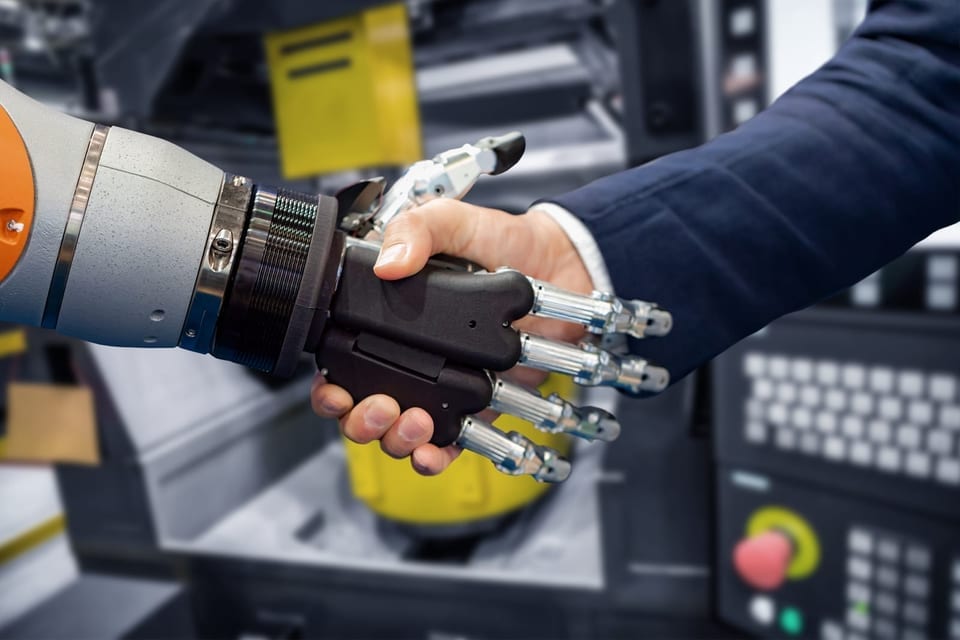
Deep learning told you something was wrong. Generative AI tells you what it means — and what to do.
Predictive maintenance has spent the last decade getting very good at one thing: spotting trouble early. Deep-learning models can now catch the faint signs of a failing bearing or a drifting pump long before a conventional alarm. But detection has always left a gap. An accurate prediction still has to be understood, explained, and turned into the right action by a human — usually at an awkward hour, under pressure. That gap is exactly where generative AI is starting to earn its place.
Where classical AI stops
Picture a 3 a.m. alert on a critical asset. In the familiar version of events, a model raises a flag, a cryptic code lands on a screen, and a junior technician has to decide whether it’s serious. Often that means a phone call to the one senior engineer who can interpret it, a hunt through binders and PDFs for the right procedure, and time lost while the clock runs.
The detection was excellent. Everything after it was slow. As we argued in our companion piece, Why “Good Enough” Maintenance Quietly Drains Saudi Plants, deep learning has largely solved reliable detection and remaining-useful-life prediction. What remains is the harder, more human work: understanding why, finding the right knowledge fast, and deciding what to do. That is the territory generative AI — and large language models in particular — was built for.
From alarm to explanation
The first shift is from codes to language. Instead of a raw alert, a model’s output and the underlying sensor patterns can be turned into a plain-language explanation: what changed, which signals drove the flag, and the most likely root causes, ranked. A technician on shift gets something they can act on, not a puzzle to escalate. Just as importantly, the explanation makes the system’s reasoning visible — which is how trust is earned on a plant floor.
A copilot that speaks your plant’s language — and Arabic
The second shift is conversation. A maintenance copilot lets an engineer simply ask: How has this pump trended over the last month? Which assets are most at risk this week? What did we do last time this fault appeared? Behind the scenes, the assistant translates that plain-language question into the right query against your sensor data, history, and KPIs, and answers in plain language back. For teams across the Kingdom, the ability to work fluently in both Arabic and English is not a nice-to-have — it puts the same capability in every operator’s hands, on every shift.
Instant answers from the manuals you already own
Every plant sits on a mountain of knowledge it can barely use in the moment: OEM manuals, P&IDs, standard operating procedures, past work orders, and failure histories. Generative AI, using an approach called retrieval-augmented generation, can search that body of documents and surface the exact, relevant answer — grounded in your own materials rather than guessed. The senior engineer’s instinct for “I know where to look” becomes something every technician can do in seconds.
The prescriptive step: telling teams what to do next
Detection says something is wrong. Prescription says here is what to do about it. This is the most operationally valuable shift of all. Drawing on the diagnosis, the asset’s history, and your procedures, a generative system can draft a context-aware work order — the likely cause, the recommended steps, the parts and skills needed — ready for a planner or engineer to review and approve. Predictive maintenance stops being a warning light and becomes a recommendation you can act on.
Learning from failures you’ve rarely seen
There is a stubborn data problem underneath all of this. Machines spend almost all of their lives running normally, so real examples of rare or critical failures are scarce — and models struggle to learn what they have barely seen. Generative techniques such as GANs, variational autoencoders, and diffusion models can synthesise realistic examples of those rare failure modes, strengthening the very models that protect your most critical assets. It is a way to prepare for the failures you can’t afford, without waiting for them to happen.
Seeing the whole picture, not just the sensors
Real diagnosis is rarely one signal. It is a vibration trace alongside a maintenance log, a thermography image, and an operator’s note. Generative AI is well suited to bringing these very different sources together — numbers, text, and images — into a single, richer read on what is actually happening. And by capturing the judgement of senior engineers and making it available to every shift, it answers directly the skills and localisation challenge facing Saudi industry: expertise that used to live in a few heads becomes something the whole organisation can draw on.
This sounds powerful — but can a cautious operator trust it?
Powerful, but on a tight leash
A healthy dose of scepticism is warranted, and good design answers it directly. Four principles matter:
- Keep the data in the Kingdom. For sensitive industrial data, on-premise and sovereign deployment options keep information inside your walls and under your control.
- Ground the AI in your reality. Models should answer from your plant’s real data and documents, not from open-ended generation, so responses stay anchored to fact. This is the single most effective guard against the “hallucinations” that worry serious buyers.
- Keep a human in the loop. Generative outputs are drafts and recommendations for an engineer to review and approve — not autonomous actions on live equipment.
- Stay inside the guardrails. Clear limits on what the system can do, plus traceable reasoning, keep it auditable and safe in a setting where mistakes carry real consequences.
Used this way, generative AI is not a black box making unaccountable calls. It is a fast, exceptionally well-read assistant that shows its work.
How Zakanova puts it together
Zakanova combines both layers in one platform. Deep-learning models handle anomaly detection, fault classification, and remaining-useful-life prognostics — the reliable detection layer. A generative layer sits on top to explain alerts in plain language, answer questions across your data and manuals in Arabic and English, and draft the recommended next action. It is designed to work with the SCADA, historian, and CMMS data you already have, to deploy in a way that respects data sovereignty, and to keep your engineers firmly in control. The aim is not to replace your experts. It is to give every shift the benefit of your best one — while protecting the uptime, safety, and asset integrity that Vision 2030’s industrial ambitions depend on.
We make no promises of guaranteed results; outcomes depend on your assets, your data, and your starting point. What we can promise is an approach grounded in your plant’s reality, not in hype.
Key takeaways
- Deep learning solved early detection and remaining-useful-life prediction; the gaps that remain are understanding, knowledge access, and action.
- Generative AI turns model outputs into plain-language explanations, conversational copilots, instant retrieval from your manuals, and ready-to-review work orders.
- Synthetic data helps models learn the rare, critical failure modes that real operations almost never produce.
- Native Arabic-and-English support, on-premise / sovereign deployment, grounding in real data, and human-in-the-loop oversight make the technology trustworthy for KSA industry.
- The destination is prescriptive maintenance: not just knowing something is wrong, but knowing what to do next.
- “From detection to decision” stack. A layered diagram: sensors at the bottom, a deep-learning prognostics layer, a generative-AI layer (explain / retrieve / recommend), and a technician taking action at the top. Alt text: “Layered diagram showing data flowing from sensors through deep-learning prognostics and a generative-AI layer to a technician’s action.”
- Maintenance copilot mockup. A chat-style interface showing a plain-language alert explanation and a suggested next step, with Arabic and English toggling. Alt text: “Mockup of a bilingual maintenance copilot explaining a fault alert and recommending a next step.”
- Synthetic-data concept. A sparse set of real failure examples beside a fuller set of AI-generated ones feeding a model. Alt text: “Diagram showing scarce real failure data supplemented by AI-generated synthetic examples to strengthen a predictive model.”